
Introduction by Richard Koszarski:
Of all the filmmakers who flourished in the Griffith period, the one with the most prepossessing artistic credentials was undoubtedly Maurice Tourneur. Born in Paris in 1876, Tourneur began his career as an illustrator and designer, and worked as assistant to Auguste Rodin and Puvis de Chavannes. Soon he turned his attention to the theater and fell under the influence of André Antoine, whose théâtre libre movement had brought the naturalist revolution to the Paris stage. By the time he entered films in 1912, Tourneur had already acquired a fondness for experimentation and for innovative approaches to staging and décor.
In 1914, the Eclair Company sent him to their large new studios at Fort Lee, New Jersey, where he began producing films at a terrific rate: three dozen in the next six years alone. Tourneur set high standards for him-self, and was universally praised for the "artistic" qualities of his work, but even he could not produce so much art to order. In the following piece he complains about some of the pressures he faces as a motion picture director, and one can't help sensing a tone of despair. His screen work after this point (1920) grew less personal, less ambitious, and less successful. In 1926 he quarreled with MGM and returned to France, where he continued directing with some success until 1948. He died in 1961
– R. K.
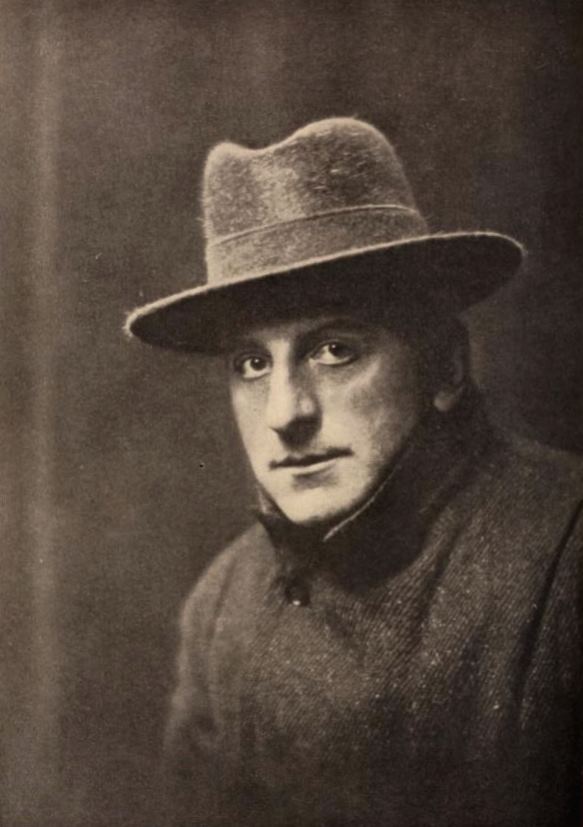
Maurice Tourneur - Exhibitors Herald (Oct. - Dec. 1920)
Meeting the public demands by Maurice Tourneur (1)
Oliver Goldsmith once said, "The little mind which loves itself will write and think with the vulgar; the great mind will be bravely eccentric, and scorn the beaten road." Had Goldsmith been a present-day producer of motion pictures he would probably never have spoken that line, for the mind that tries to be eccentric and scorn the beaten road in pictures usually leads the head in which it is contained to disaster. Making pictures is a commercial business, the same as making soap and, to be successful, one must make a commodity that will sell. We have the choice between making bad, silly, childish and useless pictures, which make a lot of money, and make everybody rich, or nice stories, which are practically lost. Nobody wants to see them. The State right buyers wouldn't buy them; if they did, the exhibitors wouldn't show them.
I remember how delighted I was when I read what the reviewers had to say about my The Blue Bird. Do you know, amongst the hundreds of exhibitors in New York, how many showed it? To my knowledge Mr. Rothapfel Rothapfel [of the Roxy Theatre] and a few fellows uptown.
The Blue Bird (1918).
Artcraft / Paramount Pictures
Those of us who are familiar with the productions of the articulate stage know very well that every time we go to see a show we sit before the curtain in a thrill of anticipation, waiting for the magic moment to come, feeling certain that we shall get an excitement of some sort or other. The orchestra plays, the footlights go on and the curtains part.
But what do we see if it is the screen? A sneering, hip-wriggling, cigarette-smoking vampire. She exercises a wonderful fascination upon every man that is brought anywhere near her, and so far as I have been able to judge, the only reason for this strange fascination is the combination of the three attributes I have already mentioned. They are good enough to apparently kill any man at fifty yards.
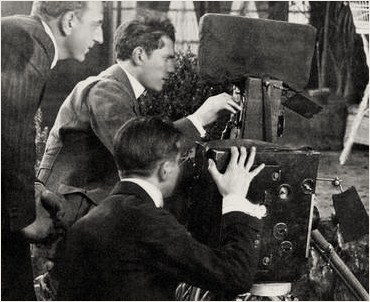
M. Tourneur (left) with his 1st cameraman Lucien Andriot (high) and 2nd cameraman John Van Den Broek
on the set of The Poor Little Rich Girl (released in 1917), Paragon Studios, Fort Lee, New Jersey
If it is not a vampire, it's a cute, curly-headed, sun-bonneted, smiling and pouting ingenue. She also is full of wonderful fascination. She runs through beautiful gardens, (always with the same nice back-lighting effects), or the poor little thing is working under dreadful factory conditions that have not been known for at least forty years. Torn between the sheer idiocy of the hero and the inexplicable hate of the heavy, is it any wonder that her sole communion is with the dear dumb animals, pigs, cows, ducks, goats – anything so long as it can't talk. If it is not either a vampire or an ingenue, it is a band of cowboys, generous-hearted, impulsive souls. They never do a stroke of work; they couldn't – they have not got time. They must be hanging around the saloon, ready to spring into the saddle and rescue the heroine, whether she is a telegraph operator or a lumberman's daughter, or a school-teacher up in the mountains. I saw all that many times, but I have yet to see a cowboy looking after a cow.
Next comes our old friend the convict. He is always innocent, but unjustly imprisoned. Although the picture is one of today and the clothes of everybody were bought last week, our unhappy convict's sole consolation is the fact that he is able to wear striped clothing, abolished years ago. He insists on wearing it; it is the one thing that reconciles him to the rigors of the prison existence, from which he escapes so easily whenever he has a mind to do so.
Another old friend is the screen doctor. Carrying always his little black bag, he enters the room where the patient lies unconscious; he feels the pulse, listens to the fluttering motions of the heart, and then one of two things occurs. If the patient is a man, the doctor steps back from the bed, takes off his hat and looks sadly at the floor. This indicates the patient is dead. If the patient is a girl, more particularly if she is the leading lady, he gives her a glass of water, and whether she fell from a thirty foot cliff, was poisoned by the villain, shot in the back by a Japanese spy or run over by the Lumberlands Express, she is instantly cured. You would imagine that the doctor would express some sort of delight at such a miracle, but he doesn't; he remains comparatively unmoved. It is only when a patient dies that he develops an intensity of sympathetic grief such as he would exhibit if the patient were his own twin brother. One thing is certain; if many of his patients die, his own life will be seriously endangered, a merely human constitution being unable to withstand many such shocks.
I could keep on describing types like those from now till the middle of next week. Up to the present time the public has not seemed to realize how bad the average picture is, because they have been rather fooled by the fact that directors have introduced new lighting effects, by the personality of the star and by tricks generally.
I would rather starve and make good pictures, if I knew they were going to be shown, but to starve and make pictures which are thrown in the ash-can is above anybody's strength. As long as the public taste will oblige us to make what is very justly called machine-made stories, we can only bow and give them what they want.
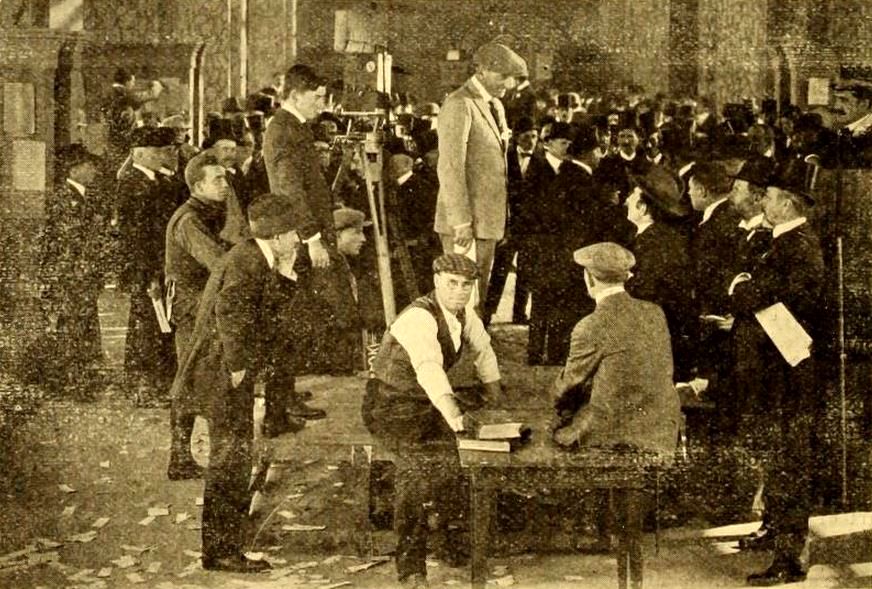
Still from The White Heather (1919) with M. Tourneur preparing
to film the stock exchange scene, Moving Picture World 22. 2.1919
Prunella was one of my productions that the reviewers spoke of as an artistic achievement. The first time I saw it shown to the public was in one of the side-shows in Atlantic City. An automatic piano furnished the musical score, which consisted of popular dance music. A week or so later it was shown in one of the leading New York theatres with success, but the managers of the smaller houses throughout the country considered it "too high brow" for their patrons. Broken Blossoms was a very good picture, but suppose it had been shown without the two Russian orchestras, the two prologues, and about fifty thousand dollars' worth of publicity, who would have gone to see it? Suppose Mr. Cecil De Mille made "The Admirable Crichton" as Barrie wrote it, instead of putting on "Male and Female" as Mr. De Mille saw it, what would have been the result? The picture wouldn't have made any money, which is not so important, but it would not have been shown, and this is the main thing to a producer, and to my mind it is going to be the greatest event of next year.
The American producers will have to change entirely their machine-made stories and come to a closer and truer view of humanity, or the foreign market is going to sweep us out with their pictures, made in an inferior way, but carried over by human, possible, different stories. I am not going to elaborate on the mental anguish of the director who has been talked into accepting a bad script that he knows is bad, because this has happened to me four times out of five and I would rather not think about it, as it is too painful and I remember only too vividly the feeling of gloom and depression with which I have walked away with a script of this sort under my arm, wondering how in the name of heaven I was going to live the next few weeks without committing suicide, or what sort of new stunt I could invent to make it get by.
Good stories are not only a necessity, but some day they will actually come. The industry is founded on the firm basis of providing healthy entertainment, and I look forward to the future with confidence. If anyone wants to awake the sleeping beauty, I certainly do, but the poor lady has been sleeping for so many years that at times it seems like an impossible job.
(1) Complete article originally written by Tourneur in Shadowland magazine in May 1920. It is moving to read about the pain, sadness, and depression that Maurice Tourneur expresses in some of these lines. We have also included the introduction by Richard Koszarski, published in Film Comment. These texts should not be forgotten; it is essential to continue spreading them and keeping them alive, as they reveal a wound that transcends the individual and the cinematic, and they can contribute to a deeper understanding of both that era and the one we live in today.
Source: Film Comment, Vol. 12, No. 4 (July-August 1976), p. 32, 34. Published by: Film Society of Lincoln CenterStable
Un comentario en «Meeting The Public Demands by Maurice Tourneur»